


Information Security Lab
- Home
- Schools
- SCOPE
- Facilities
- Information Security Lab
Information Security Lab
Overview
The Information Security Lab is a core teaching and learning facility under the School of Computer Science and Engineering (SCOPE), VIT Vellore Campus, designed to provide strong practical foundations in cybersecurity and secure computing practices. The lab supports foundational and advanced courses including Cryptography, Network Security, Ethical Hacking, Secure Software Development and Cyber Forensics. It focuses on developing security awareness, analytical thinking, and hands-on skills through systematic laboratory experiments, simulations, and project-based learning. The lab enables students to understand, implement, and evaluate security mechanisms such as encryption algorithms, authentication protocols, intrusion detection systems, vulnerability assessment, and secure system configuration.
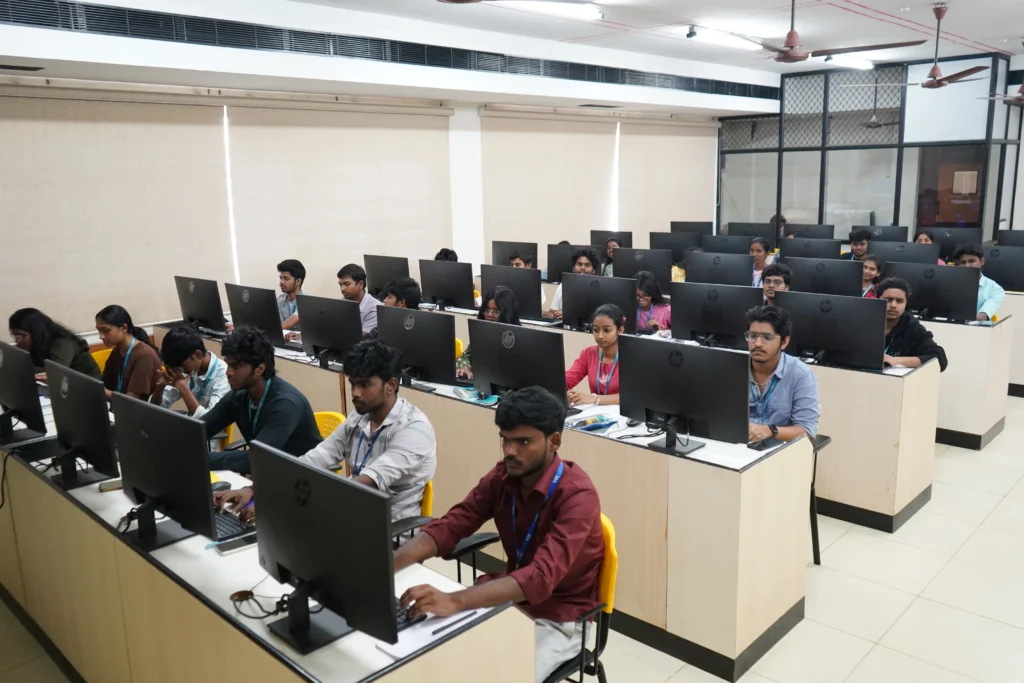
By integrating theoretical security concepts with real-world attack–defense scenarios, tool-based experimentation, and debugging practices, the Information Security Lab equips students with essential competencies required for advanced security research and professional roles in cybersecurity and information assurance.
Objectives
- To provide hands-on training core and advanced information security concepts, enabling students to design and implement secure systems.
- To strengthen analytical and problem-solving skills of students through practical exposure to real-world cybersecurity scenarios and tools.
- To support experimental research in emerging areas such as cryptography, network security, IoT security and AI-driven security solutions.
- To facilitate the development, testing, and validation of novel security mechanisms, protocols, and frameworks.
- To align laboratory practices with industry standards and equip students with practical cybersecurity skills demanded by organizations.
- To support industry collaboration through real-world security projects, tool-based training, and problem-solving activities.



Key Focus Areas
- Cryptography and Secure Communication – Implementation of encryption, authentication, hashing and key management techniques for data protection.
- Network and System Security – Configuration and evaluation of firewalls, IDS/IPS, VPNs and secure network architectures.
- Ethical Hacking and Vulnerability Assessment – Identification and analysis of system and application vulnerabilities using penetration testing tools.
- Secure Software, Cloud, and IoT Security – Secure coding practices and security assessment of modern platforms including cloud, mobile and IoT environments.
- Malware Analysis, Digital Forensics, and Incident Response – Investigation of cyber threats, evidence analysis and response to security incidents.
RESEARCH Publications
- Sasikumar, K., and Sivakumar Nagarajan. “Enhancing Cloud Security: A Multi-Factor Authentication and Adaptive Cryptography Approach Using Machine Learning Techniques.” IEEE Open Journal of the Computer Society (2025).
- Kavya, S., and D. Sumathi. “Staying ahead of phishers: a review of recent advances and emerging methodologies in phishing detection.” Artificial Intelligence Review 58, no. 2 (2024): 50.
- Sheng, Xinlei, Chen Wang, Jian Shen, Hemalatha Sattamuthu, and Niranchana Radhakrishnan. “Verifiable Private Data Access Control in Consumer Electronics for Smart Cities.” IEEE Consumer Electronics Magazine (2025).
- Nallakaruppan, M. K., Rajesh Kumar Dhanaraj, Shubhi Shukla, Karthika Subbaraj, Siddhesh Fuladi, Shitharth Selvarajan, Ahmad Alkhayyat, and Nazik Alturki. “Reliable Secured Consumer IIoT Framework with Multi Layer Attack Interpretation and Prevention.” IEEE Transactions on Consumer Electronics (2025).
- Manohari, B., and L. Thanga Mariappan. “Privacy Preserving Approach for Detection of Malicious Files.” IEEE Access 13 (2025): 189895-189902.