


Quantum Computing Lab
- Home
- Schools
- SCOPE
- Facilities
- Quantum Computing Lab
Quantum Computing Lab
Overview
The Quantum Computing Lab is designed to introduce students to the fundamental principles, models, and computational paradigms of quantum computing. This laboratory provides a practical environment where learners can explore how quantum mechanics concepts such as superposition, entanglement, and measurement are applied to computation and information processing.
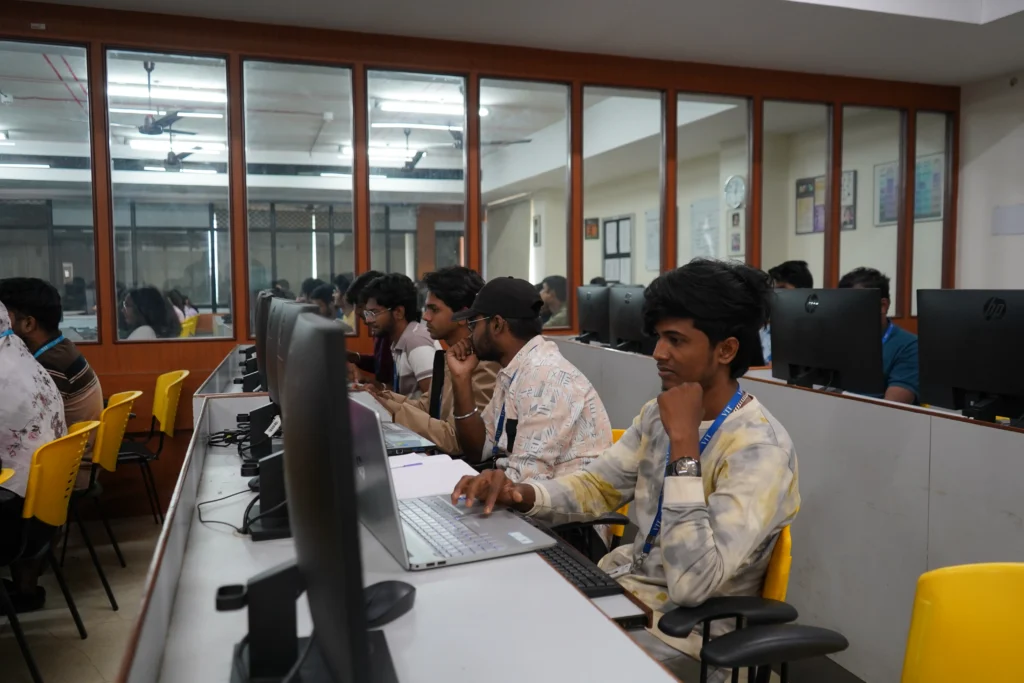
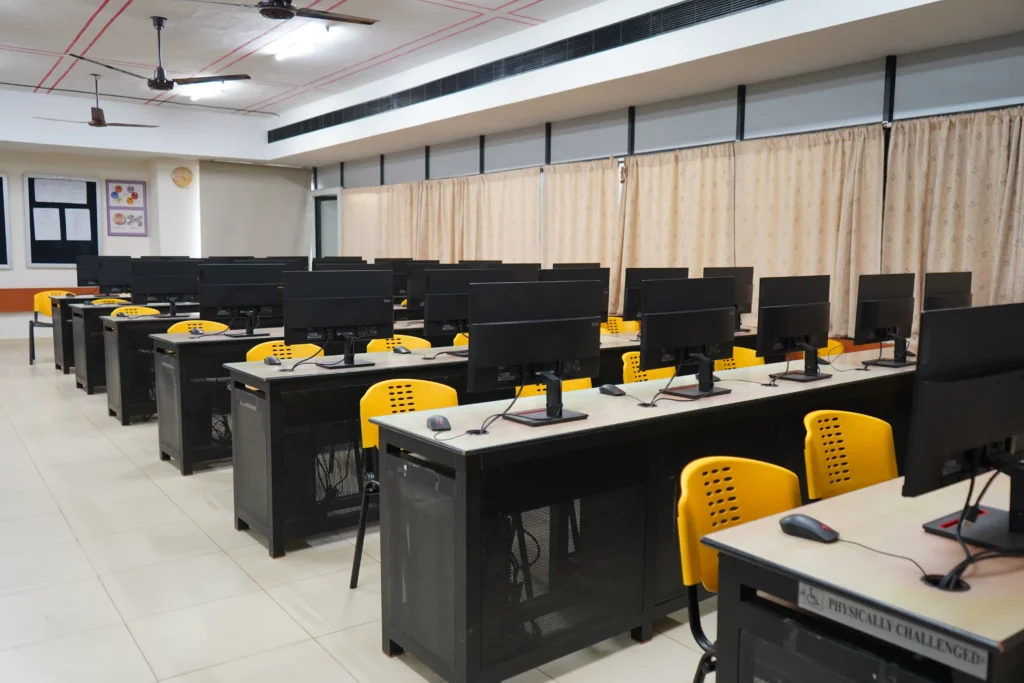
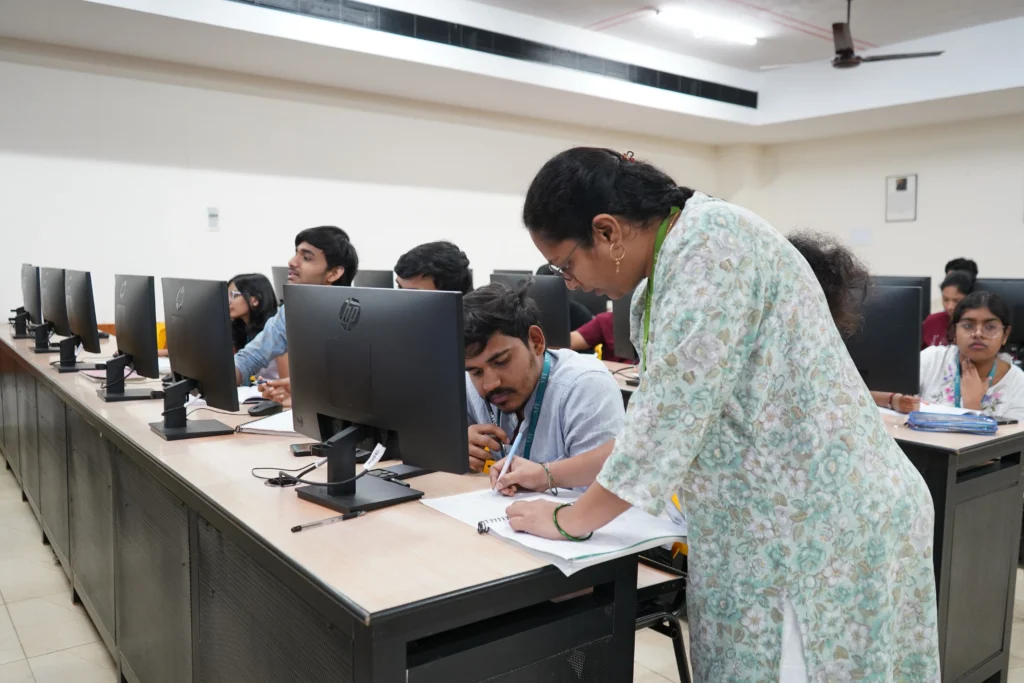
The lab has a seating capacity of 72 students and is equipped with 72 high-performance computer systems, ensuring one-to-one access for practical learning. The facility includes modern teaching aids such as a projector, whiteboard, and air-conditioning, providing a comfortable and technology-enabled learning environment. PRP 356 enables hands-on implementation of programming concepts and system-level experiments, reinforcing theoretical knowledge through practical exposure.
The lab has a seating capacity of 72 students and is equipped with 72 high-performance computer systems, ensuring one-to-one access for practical learning. The facility includes modern teaching aids such as a projector, whiteboard, and air-conditioning, providing a comfortable and technology-enabled learning environment. PRP 356 enables hands-on implementation of programming concepts and system-level experiments, reinforcing theoretical knowledge through practical exposure.
Objectives
- To reinforce theoretical concepts through practical experimentation
- To develop strong programming and debugging skills
- To familiarize students with real-world development environments.
- To enhance algorithmic thinking and data handling capabilities
- To gain hands-on experience with operating system commands and shell scripting.
Key Focus Areas
- Foundations of Quantum Computing: Research and experimentation on quantum mechanics principles relevant to computation, including qubits, superposition, entanglement, and quantum measurement.
- Quantum Algorithms and Complexity:
Design, analysis, and implementation of quantum algorithms for problems in optimization, cryptography, search, simulation, and machine learning, with emphasis on computational advantages over classical methods. - Quantum Programming and Software Tools:
Development and use of quantum programming frameworks, simulators, and compilers, along with studies on quantum circuit design and optimization. - Quantum Hardware and Architectures:
Exploration of quantum hardware technologies such as superconducting qubits, trapped ions, and photonic systems, including noise characterization and performance evaluation. - Quantum Error Correction and Fault Tolerance:
Investigation of error models, error mitigation techniques, and fault-tolerant quantum computation to improve reliability and scalability. - Quantum Communication and Cryptography:
Study of quantum key distribution, quantum networks, and post-quantum cryptographic protocols for secure communication. - Quantum Simulation of Physical Systems:
Use of quantum computers to simulate quantum systems in chemistry, material science, and condensed matter physics. - Hybrid Quantum–Classical Computing:
Research on variational algorithms and hybrid workflows that integrate quantum processors with classical computing resources. - Education, Training, and Skill Development:
Curriculum development, hands-on laboratory sessions, workshops, and student projects aimed at building foundational and advanced skills in quantum computing. - Interdisciplinary and Industry Collaboration:
Collaborative research with academia and industry to translate quantum computing research into practical applications and real-world solutions.
Research Publications
- Savadatti, Shreya, Aswani Kumar Cherukuri, Annapurna Jonnalagadda, and Athanasios V. Vasilakos. “Analysis of quantum fully homomorphic encryption schemes (QFHE) and hierarchial memory management for QFHE.” Complex & Intelligent Systems 11, no. 6 (2025): 1-28. (SCIE-IF-4.6)
- Bhaskaran, P., and S. Prasanna. “An accuracy analysis of classical and quantum-enhanced K-nearest neighbor algorithm using Canberra distance metric.” Knowledge and Information Systems 67, no. 1 (2025): 767-788. (SCIE-IF-3.1)
- Bakshi, Kanishk, and Kathiravan Srinivasan. “Quantum inspired qubit qutrit neural networks for real time financial forecasting.” Scientific Reports 15, no. 1 (2025): 28711. (SCIE- IF-3.9)
- Ranganathan, Arun, A. Viswanathan, M. Umamaheswari, and N. Krishnaraj. “Ultrafast Laser-induced Silver Nanostructures for Plasmon-Enhanced Detection of Cancer Cell Metabolic Dynamics.” Plasmonics (2025): 1-14. (SCIE- IF-4.3)
- Aishwarya, C., M. Venkatesan, and P. Prabhavathy. “A Scoping Survey of Quantum Machine Learning and Deep Learning for Real-World Applications.” Procedia Computer Science 258 (2025): 633-646. (SCOPUS)