

School of Civil Engineering (SCE) - UG
School of Civil Engineering (SCE)
Welcome to VIT, School of Civil Engineering.
The right knowledge and skill will help to attain professional and personal goals. UG programme is designed for adverse spectrum of courses and for enriching students through a multidisciplinary approach for a well-rounded knowledge base and transferable skills. To enhance the learning experience, students may choose international transfer programme or participate in the semester aboard programme. Bachelor degree in civil engineering is accredited by the Engineering Accreditation Commission of ABET.
Number of courses offered in Vellore-1, Chennai-1
- 1. B.Tech – Civil Engineering
- 1. B.Tech – Civil Engineering
- B.Tech - Civil Engineering
- About the Programme
- Programme Educational Objectives (PEOs)
- Knowledge and Attitude Profiles (WK)
- Programme Outcomes (POs)
- Programme Specific Outcome (PSO)
- Programme Core Courses
- Programme Elective Courses
- Infrastructure
- Scope of employment
- Curriculum
The School of Civil Engineering offers B.Tech. programme in Civil Engineering to the candidates selected through VITEEE (VIT Engineering Entrance Examination).
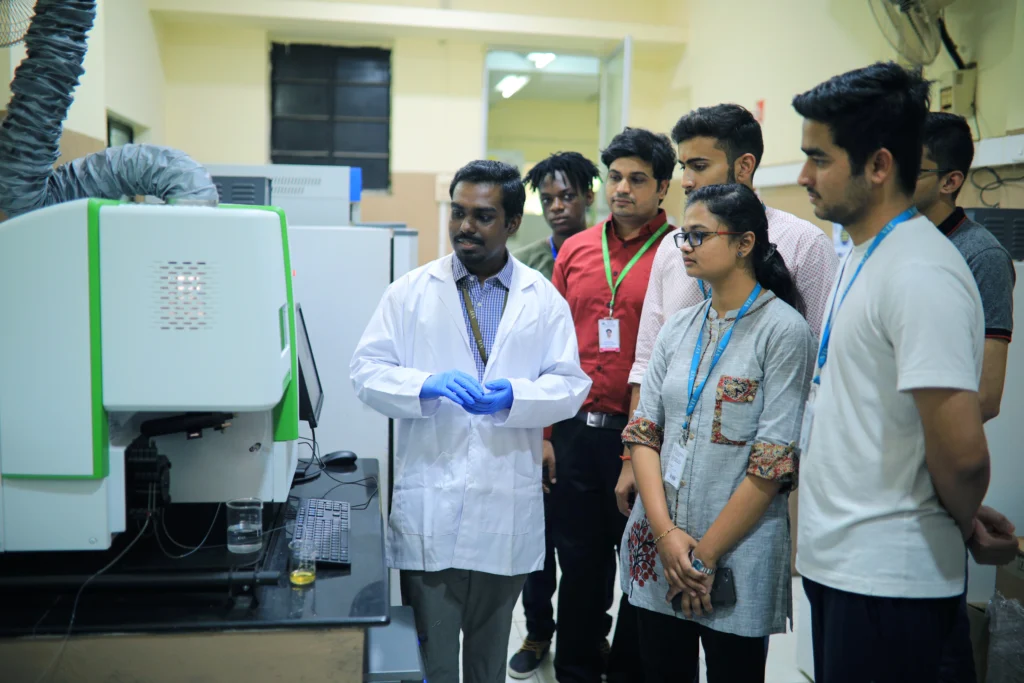
B.Tech. Civil engineering is one of the oldest undergraduate programs at Vellore Institute of Technology, Vellore, established in 1984. Through state-of-the-art laboratory facilities, this four-year program gives the students the most up-to-date technical knowledge in the field of Civil Engineering. This program provides a platform to enrich technical knowledge in various domains of Civil Engineering, through industrial visit and inviting the experts to share their knowledge on real-world problems. The program's faculty members are knowledgeable and experienced in the broad field of Civil Engineering, both nationally and internationally.
The program offers the graduates to:
- Provide long-term solutions to Civil Engineering issues by creating and implementing cutting-edge, creative techniques and technology.
- Plans, designs, constructions, and social economics operate to protect and restore the natural environment.
- Use current techniques, advanced materials, equipment, and management tools to finish the Civil Engineering project within the schedule and budget constraints.
- Place them as full-time or job interns at various reputable organizations based on their performance and prepare them for opportunities to pursue higher education both in India and abroad.
Also School of Civil Engineering offers B.Tech. Civil Engineering Program in Partnership with L&T EduTech
The B.Tech. Civil Engineering program at VIT, developed in collaboration with L&T EduTech, is a pioneering initiative that redefines Civil Engineering education. This four-year undergraduate program combines academic rigor with practical relevance, offering a transformative learning experience designed to bridge the gap between classroom concepts and industry requirements.
Through a carefully structured curriculum that blends in-depth theoretical instruction with real-world applications, students gain not only a solid technical foundation but also industry-relevant problem-solving skills essential for success in the evolving engineering landscape.
Program Highlights:
- A holistic and immersive educational experience that prepares graduates for both immediate job placements and long-term, future-focused careers.
- A comprehensive approach that opens doors to academic progression and professional growth.
- Access to internships and career opportunities via the Skill Exchangeplatform, aligned with the needs of L&T group companies—including L&T Construction—and other industry partners of L&T EduTech.
PEO-1: Graduates will become successful Civil Engineering professionals / entrepreneur.
PEO-2: Graduates will pursue higher studies and research for professional
development.
PEO3: Graduates will demonstrate civic responsibility in addressing societal and environmental challenges.
WK1: A systematic, theory-based understanding of the natural sciences applicable to the discipline and awareness of relevant social sciences.
WK2: Conceptually-based mathematics, numerical analysis, data analysis, statistics and formal aspects of computer and information science to support detailed analysis and modelling applicable to the discipline.
WK3: A systematic, theory-based formulation of engineering fundamentals required in the engineering discipline.
WK4: Engineering specialist knowledge that provides theoretical frameworks and bodies of knowledge for the accepted practice areas in the engineering discipline;
WK5: Knowledge, including efficient resource use, environmental impacts, whole-life cost, re-use of resources, net zero carbon and similar concepts that supports engineering design and operations in a practice area.
WK6: Knowledge of engineering practice (technology) in the practice areas in the engineering discipline.
WK7: Knowledge of the role of engineering in society and identified issues in engineering practice in the discipline, such as the professional responsibility of an engineer to public safety and sustainable development.
WK8: Engagement with selected knowledge in the current research literature of the discipline, awareness of the power of critical thinking and creative approaches to evaluate emerging issues.
WK9: Ethics, inclusive behavior and conduct. Knowledge of professional ethics, responsibilities, and norms of engineering practice. Awareness of the need for diversity by reason of ethnicity, gender, age, physical ability etc. with mutual understanding and respect and of inclusive attitudes.
PO1: Engineering Knowledge: Apply knowledge of mathematics, natural science, computing, engineering fundamentals and an engineering specialization as specified in WK1 to WK4 respectively to develop to the solution of complex engineering problems.
PO2: Problem Analysis: Identify, formulate, review research literature and analyze complex engineering problems reaching substantiated conclusions with consideration for sustainable development. (WK1 to WK4)
PO3: Design / Development of Solutions: Design creative solutions for Complex engineering problems and design / develop systems / components / processes to meet identified needs with consideration for the public health and safety, whole-life cost, net zero carbon, culture, society and environment as required. (WK5)
PO4: Conduct Investigations of Complex Problems: Conduct investigations of Complex engineering problems using research-based knowledge including design of experiments, modelling, analysis & interpretation of data to provide valid conclusions. (WK8)
PO5: Engineering Tool Usage: Create, select and apply appropriate techniques, resources and modern engineering & IT tools, including prediction and modelling recognizing their limitations to solve complex engineering problems. (WK2 and WK6)
PO6: The Engineer and The World: Analyze and evaluate societal and Environmental aspects while solving complex engineering problems for its impact on sustainability with reference to economy, health, safety, legal framework, culture and environment. (WK1, WK5 and WK7)
PO7: Ethics: Apply ethical principles and commit to professional ethics, human values, diversity and inclusion; adhere to national & international laws. (WK9)
PO8: Individual and Collaborative Team work: Function effectively as an Individual and as a member or leader in diverse / multi-disciplinary teams.
PO9: Communication: Communicate effectively and inclusively within the Engineering community and society at large, such as being able to comprehend and write effective reports and design documentation, make effective presentations considering cultural, language and learning differences
PO10: Project Management and Finance: Apply knowledge and understanding of engineering management principles and economic decision-making and apply these to one’s own work, as a member and leader in a team and to manage projects and in multidisciplinary environments.
PO11: Life-Long Learning: Recognize the need for, and have the preparation and ability for i) independent and life-long learning ii) adaptability to new and emerging technologies and iii) critical thinking in the broadest context of technological change. (WK8)
PSO-1: Apply core civil engineering principles in structural, geotechnical, transportation, environmental and water resources engineering to create resilient infrastructure.
PSO-2: Apply emerging technologies to plan, model, design and manage civil engineering projects to meet global infrastructure needs.
PSO-3: Analyse societal challenges and develop innovative solutions for the sustainable built environment.
- Digital Surveying
- Environmental Engineering
- Mechanics of Solids
- Fluid Mechanics and Hydraulic Machines
- Soil Mechanics and Foundation Engineering
- Structural Analysis
- Transportation Engineering
- Design of Steel and Reinforced Concrete Structures
- Estimation, Costing, and Drawing
- Artificial Intelligence and Machine Learning in Civil Engineering
- Construction Materials and Techniques
- Concrete Technology
- Digital Management and Practices in construction
- Hydrology and Water Resources Engineering
- Engineering Geology.
- Prefabricated Structures
- Pre-Stressed Concrete and Industrial Structures
- Additive Manufacturing for Construction
- Construction Quality and Safety
- Groundwater Engineering
- Environmental Impact Assessment
- Industrial Waste Management
- Air and Noise Pollution Control
- Solid Waste Management
- Resource Management and Circular Economy
- Traffic Engineering
- Ground Improvement Techniques
- Geotechnical Earthquake Engineering
- AI in Climate-Resilient Infrastructure
- Unmanned Aerial Systems in Transportation Systems
- Digital Project Management
- Smart Buildings and Energy Performance
- Structural Health Monitoring
- Digital Twins in Built Environment
- Survey Lab.
- Civil Engineering Computing Centre.
- Concrete Technology Lab.
- Strength of Materials Lab.
- Advanced Strength of Materials Lab.
- Structural Engineering Lab.
- Civil Engineering Non- Destructive Testing Lab.
- Environmental Engineering Lab.
- Fluid Machinery Lab.
- Geotechnical Engineering Lab.
- Transportation Engineering Lab.
- Heritage Research Lab.
- Government Organisations such as PWD, Highways, Railways, Survey of India etc.
- Construction Companies such as L&T, HCC, TECHNIP, GMR, SP, ESSAR, CCCL, Godrej properties and TCE.
- Research & Development Organisations.
- B.Tech - Civil Engineering - VIT Chennai