


Microwave Lab
- Home
- Schools
- SENSE
- Facilities
- Microwave Lab
Microwave Lab - SENSE
Overview
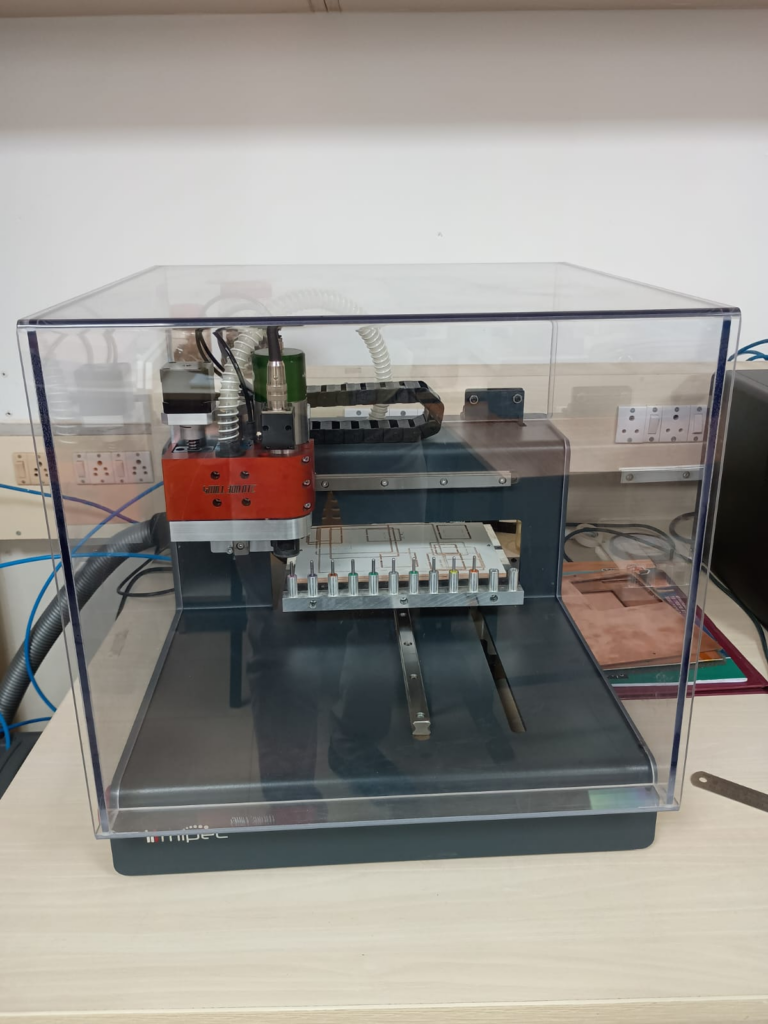
The Microwave Engineering Laboratory provides a modern, end-to-end design, prototyping, and testing ecosystem for high-frequency electronics. The facility bridges deep electromagnetic theory with physical hardware implementation through a strict, three-stage industrial engineering pipeline: 3D EM CAD Simulation → In-House Chemical-Free Substrate CNC Milling → Precision RF Test and Verification.
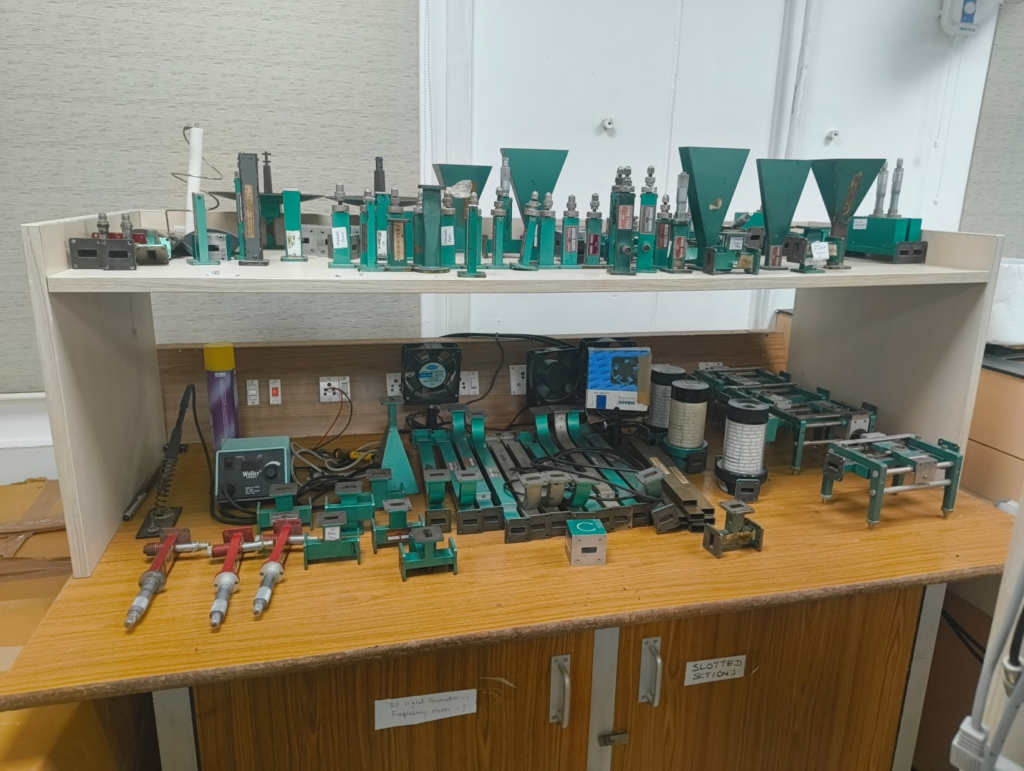
Equipped with dedicated X-Band guided wave test benches, an extensive modular waveguide component ecosystem, and automated computer-numerical-control (CNC) circuit board fabrication, this laboratory trains students to master the entire physical lifecycle of high-frequency components from initial concept to a validated hardware prototype.
Objectives
- Empirical Validation of EM Fields: Translate theoretical vector electromagnetic and wave equations into observable, measurable phenomena using physical waveguide media.
- Mastery of Industrial Instrumentation: Train students in the calibration, operation, and troubleshooting of specialized high-frequency microwave benches and Vector Network Analyzers (VNAs).
- Chemical-Free Rapid Prototyping: Cultivate technical proficiency in modern, environmentally safe substrate milling using automated tool-changing CNC machinery.
- Research and Innovation Readiness: Provide the specialized infrastructure required to design and benchmark physical prototypes for 5G/6G communication networks, satellite feeds, and radar subsystems.
Key Focus Areas
- Waveguide Network Characterization
Empirical benchmarking of passive multi-port devices—including directional couplers, isolators, circulators, and hybrid junctions—across standard industrial frequency profiles. - Planar RF Circuit & Antenna Prototyping
Rapid mechanical fabrication of microstrip transmission lines, planar filters, impedance matching networks, and patch antenna arrays directly onto low-loss substrates. - High-Frequency Transmission Diagnostics
Precision analysis of standing wave patterns, voltage standing wave ratios (VSWR), guide wavelengths, and phase velocity inside rectangular waveguide channels. - End-to-End Design Flow Automation
Developing a seamless workspace transition from computer-aided design (CAD) layout generation to Computer-Aided Manufacturing (CAM) machine code processing.
Running Academic courses
Infrastructure and workbench Details
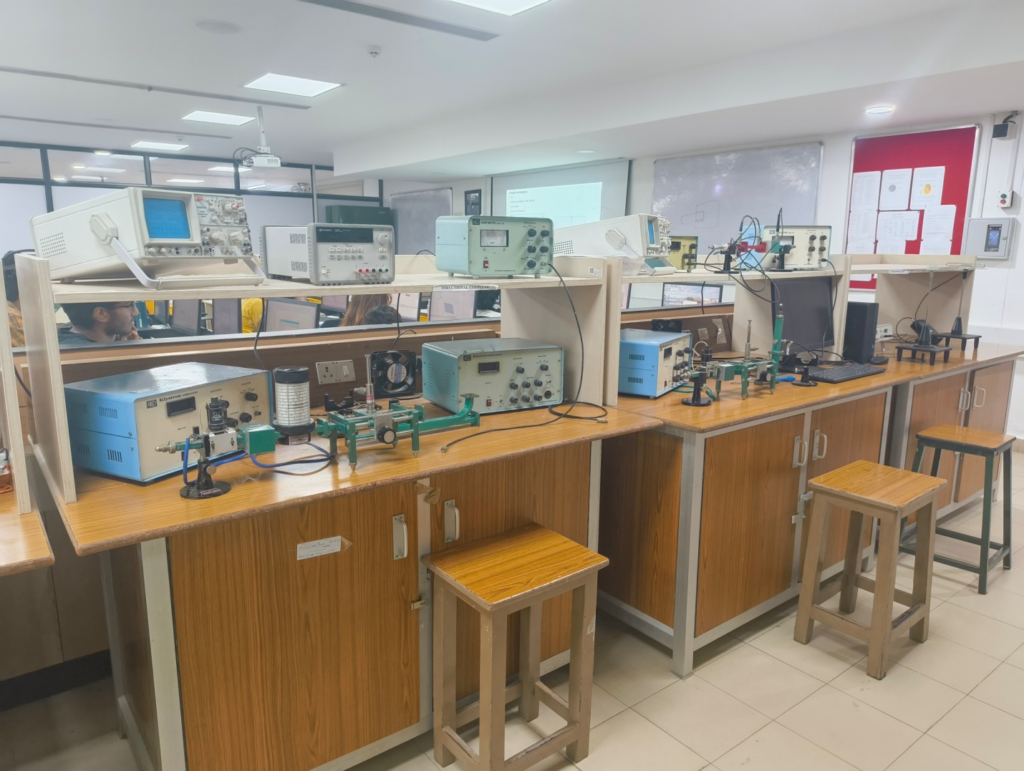
Laboratory consists of 7 fully equipped test benches running concurrently. It comfortably supports small group of students per workbench to ensure comprehensive, hands on tool manipulation.
Equipments
Oscilloscope : 0-30MHZ
Klystron Powersupply : 0-300V
VSWR meter : 0-70DB
Waveguide Components
Key Experiments conducted
- Junctions and Network characterization
- Active devices and Amplifiers
- Microwave filters and matching
- Passive Microwave components and dividers
Location
- TT145
- Lab In-charge: Dr. Rajesh N