


Communication Engineering And Analog Circuits Lab
- Home
- Schools
- SENSE
- Facilities
- Communication Engineering And Analog Circuits Lab
Communication Engineering And Analog Circuits Lab
Overview
The Communication Engineering and Analog Circuits Lab is a core teaching and experiential learning facility within the School of Electronics Engineering (SENSE), VIT Vellore Campus. The laboratory provides students with hands-on exposure to the fundamental principles, implementation, and performance analysis of analog and digital communication systems. It supports a comprehensive range of experiments covering analog modulation and demodulation techniques such as AM, DSB-SC, SSB-SC, FM, and PM, along with superheterodyne receiver concepts, mixers, pre-emphasis and de-emphasis, and noise characterization. The laboratory also facilitates practical understanding of pulse modulation, multiplexing, waveform coding, line coding, bandpass modulation, BER analysis, pseudo-noise sequences, and multiple-access techniques. Students develop practical skills by constructing, testing, and evaluating communication circuits and systems, thereby strengthening the connection between theoretical concepts and real-world communication technologies. Applying sensors in real-world electronics and instrumentation applications.
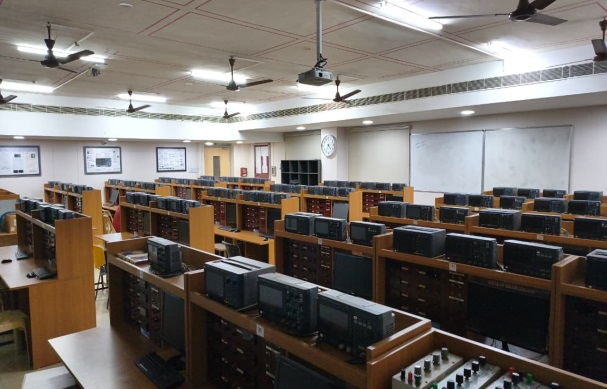
Through structured experiments and measurement-based analysis, the laboratory enables students to understand signal generation, modulation, transmission, detection, noise performance, coding, and the evaluation of communication systems. It provides a strong foundation for further learning and research in wireless communication, digital communication, signal processing, and modern communication networks.
Objectives
- To develop practical understanding of analog and digital communication principles through the implementation and analysis of communication circuits and systems.
- To provide hands-on experience in designing, constructing, and troubleshooting modulators and demodulators for analog and digital communication systems.
- To analyze the effects of modulation parameters and noise on communication system performance using measures such as SNR, noise voltage, noise figure, noise temperature, and BER.
- To develop practical proficiency in waveform coding, line coding, bandpass modulation, and pulse modulation techniques for efficient signal transmission., and prototype development for research-oriented projects.
- To familiarize students with multiplexing, pseudo-noise sequences, spread-spectrum concepts, and multiple-access techniques used in modern communication systems.
- To strengthen experimental, measurement, troubleshooting, and technical documentation skills by integrating theoretical concepts with laboratory-based implementation.
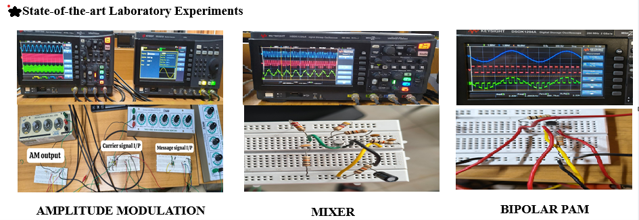
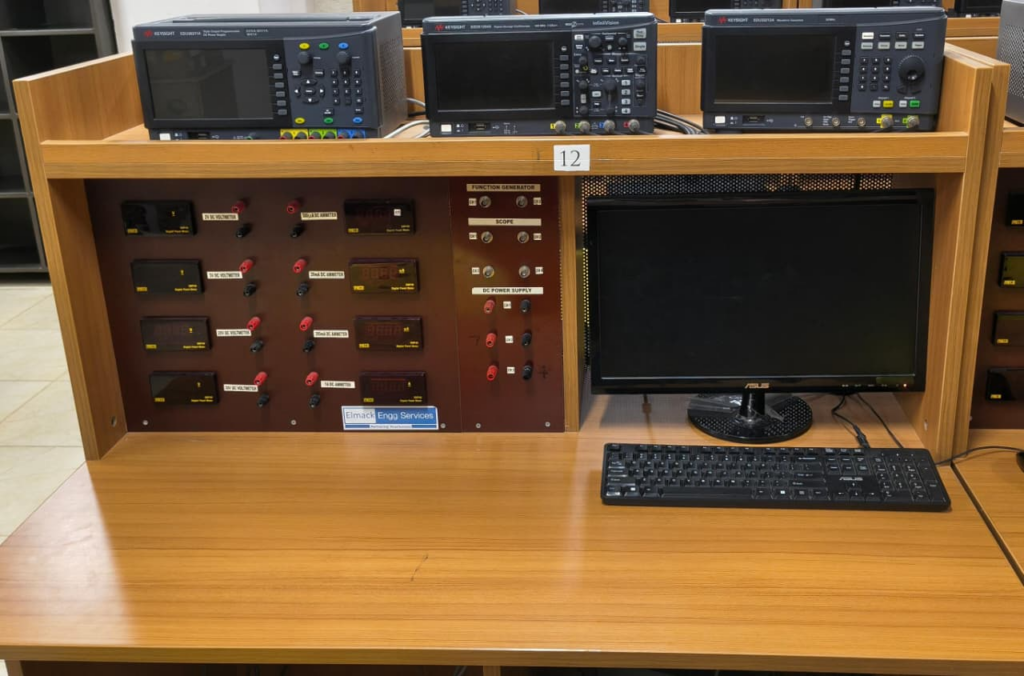
State-of-the-art experimental workstation for communication system analysis and measurement.
Key Focus Areas
- Analog Communication: Implementation and analysis of AM, DSB-SC, SSB-SC, FM, and PM modulation and demodulation techniques, including superheterodyne receivers and mixers
- Pulse Modulation and Multiplexing: Generation and analysis of PAM, PPM, and PWM signals, along with practical implementation of TDM and FDM techniques.
- Digital Communication and Signal Analysis: Implementation of PCM, DPCM, DM, line coding, bandpass modulation, and BER analysis for reliable digital communication.
- Advanced Experiments and Project-Based Learning: Hands-on development of integrated communication systems and complex experimental setups that combine modulation, coding, multiplexing, noise analysis, and performance evaluation, fostering system-level design and problem-solving skills
TT501
Current Lab In-Charge: Dr. Hemanta Kumar Sahu
Lab Technician: Mr.Rajendiran S