

- About the Programme
- Programme Educational Objectives (PEOs)
- Knowledge and Attitude Profiles(WK)
- Programme Outcomes (POs)
- Programme Specific Outcomes (PSOs)
- Programme Core Courses
- Programme Elective Courses
- Infrastructure
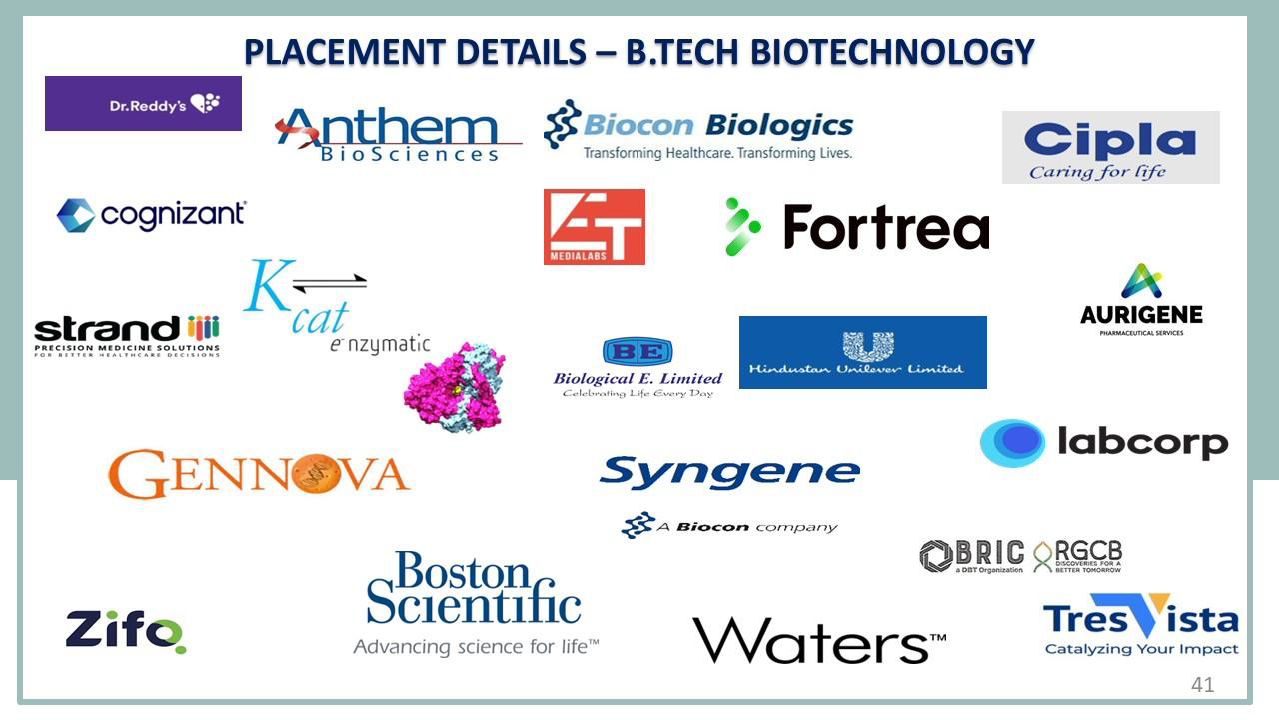
- Scope of employment
- Curriculum
B.Tech. in Biotechnology prepares engineers for fulfilling and dynamic careers in biotechnology and associated professions. Our extensive integrated programme core and elective courses with laboratory research, training in current industry practices, and the soft skills necessary to excel in business, prepare our graduates to address and lead advances in healthcare, industrial biotechnology and more.
- PEO1: Graduates will apply knowledge of applied biotechnology to engage in higher education and sustain successful employment.
- PEO2: Graduates will develop sustainable solutions to support local and global economic growth using technical and problem-solving skills in biotechnology.
- PEO3: Graduates will function effectively in diverse professional environments with social awareness, responsibility and ethical values.
- WK1: A systematic, theory-based understanding of the natural sciences applicable to the discipline and awareness of relevant social sciences.
- WK2: Conceptually-based mathematics, numerical analysis, data analysis, statistics and formal aspects of computer and information science to support detailed analysis and modelling applicable to the discipline.
- WK3: A systematic, theory-based formulation of engineering fundamentals required in the engineering discipline.
- WK4: Engineering specialist knowledge that provides theoretical frameworks and bodies of knowledge for the accepted practice areas in the engineering discipline;
- WK5: Knowledge, including efficient resource use, environmental impacts, whole-life cost, re-use of resources, net zero carbon and similar concepts that supports engineering design and operations in a practice area.
- WK6: Knowledge of engineering practice (technology) in the practice areas in the engineering discipline.
- WK7: Knowledge of the role of engineering in society and identified issues in engineering practice in the discipline, such as the professional responsibility of an engineer to public safety and sustainable development.
- WK8: Engagement with selected knowledge in the current research literature of the discipline, awareness of the power of critical thinking and creative approaches to evaluate emerging issues.
- WK9: Ethics, inclusive behavior and conduct. Knowledge of professional ethics, responsibilities, and norms of engineering practice. Awareness of the need for diversity by reason of ethnicity, gender, age, physical ability etc. with mutual understanding and respect and of inclusive attitudes.
- PO1: Engineering Knowledge: Apply knowledge of mathematics, natural science, computing, engineering fundamentals and an engineering specialization as specified in WK1 to WK4 respectively to develop to the solution of complex engineering problems.
- PO2: Problem Analysis: Identify, formulate, review research literature and analyze complex engineering problems reaching substantiated conclusions with consideration for sustainable development. (WK1 to WK4)
- PO3: Design / Development of Solutions: Design creative solutions for Complex engineering problems and design / develop systems / components / processes to meet identified needs with consideration for the public health and safety, whole-life cost, net zero carbon, culture, society and environment as required. (WK5)
- PO4: Conduct Investigations of Complex Problems: Conduct investigations of Complex engineering problems using research-based knowledge including design of experiments, modelling, analysis & interpretation of data to provide valid conclusions. (WK8)
- PO5: Engineering Tool Usage: Create, select and apply appropriate techniques, resources and modern engineering & IT tools, including prediction and modelling recognizing their limitations to solve complex engineering problems. (WK2 and WK6)
- PO6: The Engineer and The World: Analyze and evaluate societal and Environmental aspects while solving complex engineering problems for its impact on sustainability with reference to economy, health, safety, legal framework, culture and environment. (WK1, WK5 and WK7)
- PO7: Ethics: Apply ethical principles and commit to professional ethics, human values, diversity and inclusion; adhere to national & international laws. (WK9)
- PO8: Individual and Collaborative Team work: Function effectively as an Individual and as a member or leader in diverse / multi-disciplinary teams.
- PO9: Communication: Communicate effectively and inclusively within the Engineering community and society at large, such as being able to comprehend and write effective reports and design documentation, make effective presentations considering cultural, language and learning differences
- PO10: Project Management and Finance: Apply knowledge and understanding of engineering management principles and economic decision-making and apply these to one’s own work, as a member and leader in a team and to manage projects and in multidisciplinary environments.
- PO11: Life-Long Learning: Recognize the need for, and have the preparation and ability for i) independent and life-long learning ii) adaptability to new and emerging technologies and iii) critical thinking in the broadest context of technological change. (WK8)
- PSO1: Solve real-world problems related to biotechnology using domain knowledge and critical thinking.
- PSO2: Innovate sustainable solutions through scientific research in biotechnology for industrial applications.
- PSO3: Implement cutting-edge techniques, and bio-safety practices that address environmental, and societal challenges.
- Biochemistry
- Microbiology
- Cell Biology and Genetics
- Analytical Techniques in Biotechnology
- Molecular Biology
- Principles of Chemical Engineering
- Bioinformatics
- Principles of Bioprocess Engineering
- Genetic Engineering
- Genomics and Proteomics
- Biochemical Engineering
- Immunology
- Animal Biotechnology
- Plant Biotechnology
- Industrial Biotechnology
- Downstream Processing
- AI in Biology
- Biobusiness
- Pharmaceutical Biotechnology
- Regenerative Medicine
- Stem Cell Technology
- Environmental Biotechnology
- Nanobiotechnology
- Tissue Engineering
- Forensic Science and Technology
- Food Process Engineering
- Medical Diagnostics
- Food Biotechnology
- Cancer Biology and Informatics
- Protein Engineering and Design
- Technical Answers to Real Problems Project
- Design Project
- Laboratory Project
- Product Development Project
- Reading Course
- Special Project
- Simulation Project
- Molecular Modelling and Drug Design
- Neurobiology and Cognitive Science
- Industrial Enzymology
- Emerging and Re-emerging Infectious Diseases
- Biological Data Analysis and Simulation
- Computational Biology
- Biomaterials
- Anatomy and Physiology
- Clinical Data Management
- Pharmacoinformatics
- Preclinical Drug Discovery and Development
- Heat and Mass Transfer
- Applied Biology Lab
- Bioinspired Design
- Food, Nutrition and Health
- Systems Biology
The B.Tech. Biotechnology programme at the School of Bio Sciences and Technology is supported by a comprehensive laboratory ecosystem comprising dedicated teaching laboratories, advanced instrumentation facilities, a UG project laboratory, specialized research laboratories, and Centre of Excellence. The infrastructure provides students with hands-on exposure to contemporary biotechnology techniques and supports curriculum-based practical learning, undergraduate projects, research, and innovation.
Teaching Laboratories
The programme has 10 dedicated teaching laboratories supporting practical courses across major domains of biotechnology:
- Biochemistry Laboratory
- Cell & Molecular Biology Laboratory
- Bioprocess Engineering Laboratory
- Downstream Processing Laboratory
- Genetic Engineering Laboratory
- Microbiology Laboratory
- Bioanalytical & Instrumentation Laboratory
- Immunology Laboratory
- Bioinformatics Laboratory
- Computational Biology Laboratory
Advanced Instrumentation Facilities
- Instrumentation Laboratory – I
- Instrumentation Laboratory – II
- NABL-Accredited Scanning Electron Microscope (SEM) Laboratory
Undergraduate Project Laboratory
A dedicated UG Project Laboratory supports final-year undergraduate capstone projects and faculty-guided research. The facility provides wet-laboratory facilities, analytical instruments, computing resources, and relevant software for experimental investigations, data analysis, prototype development, and innovation-oriented project work.
Key Equipment & Instrumentation
- Bioprocess & Downstream: Fermenters/Bioreactors, Incubator Shakers, Refrigerated Centrifuges, Freeze Dryer (Lyophilizer)
- Molecular & Microbiology: PCR/Thermal Cyclers, Gel Documentation System, Laminar Air Flow Cabinets, CO₂ Incubators, Autoclaves, Inverted/Phase Contrast Microscopes
- Analytical & Characterization: UV–Visible Spectrophotometers, HPLC, Mass Spectrometer, FTIR Spectrometer, Flow Cytometer, Zeta Potential Analyzer
- Advanced & Computational: SEM with EDAX, High-Performance Computing (HPC) Server
Research Infrastructure
The department is supported by 32 specialized research laboratories located across the Sir M. Visvesvaraya Building, Technology Tower, and Pearl Research Park. These facilities cover diverse areas including molecular biology, biotechnology, bioinformatics, bioprocess engineering, biomaterials, medical biotechnology, computational biology, and allied disciplines. The research infrastructure is further strengthened through externally funded projects and centralized advanced instrumentation facilities.
Centre of Excellence
The research ecosystem is further strengthened by four specialized Centres of Excellence:
- Centre for Nanobiotechnology (CNBT)
- Centre for Biomaterials, Cellular and Molecular Theranostics (CBCMT)
- Centre for Bio Separation Technology (CBST)
- Centre for Advanced Research in Bacteriophage and Infectious Diseases (CARBID)
These Centres support advanced research, interdisciplinary collaboration, innovation, translational research, and advanced student project activities.
- Biotechnology has applications in many industries; professionals can choose to work for a variety of organizations, including government agencies, private companies, regulatory bodies, or clinical laboratories.
- Biotechnology employers range in size and type from small start-ups to global pharmaceutical leaders to Government-funded organizations
- The Biotechnology field—and its careers—span other functional areas that are just as integral in getting a meaningful biotechnology product to market.
These areas include:
- Research and development
- Quality assurance/regulatory affairs
- Manufacturing
- Clinical research
- Government (policymaking)
- Software engineering
- Food, animal, and environmental science
- Sales and technical support
- Business management
- Project management