


Artificial Intelligence Lab
Artificial Intelligence Lab
Overview
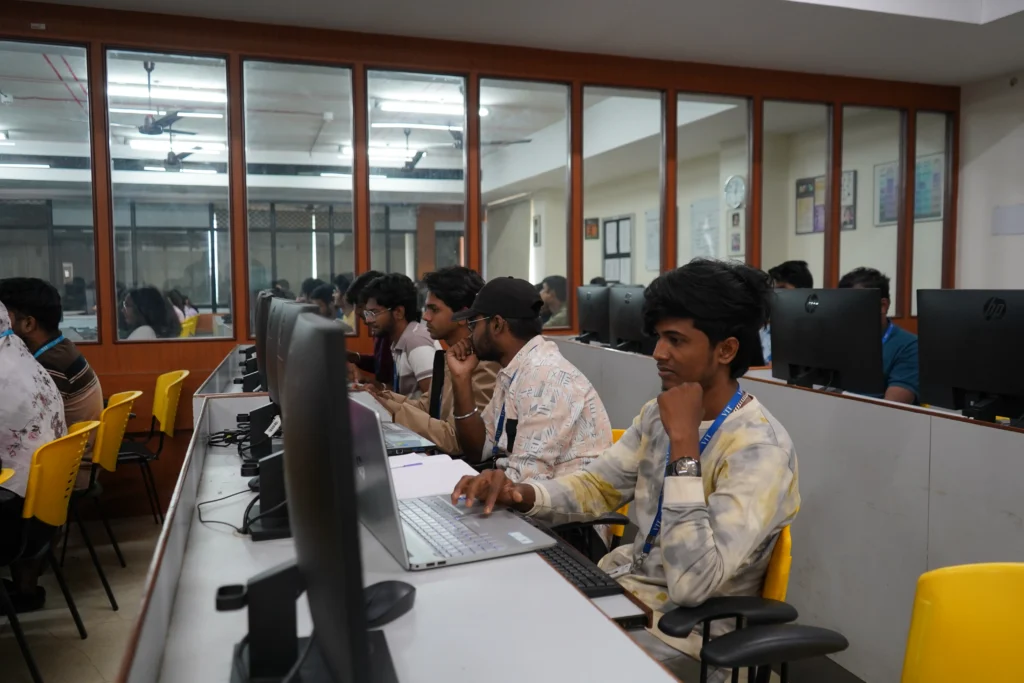
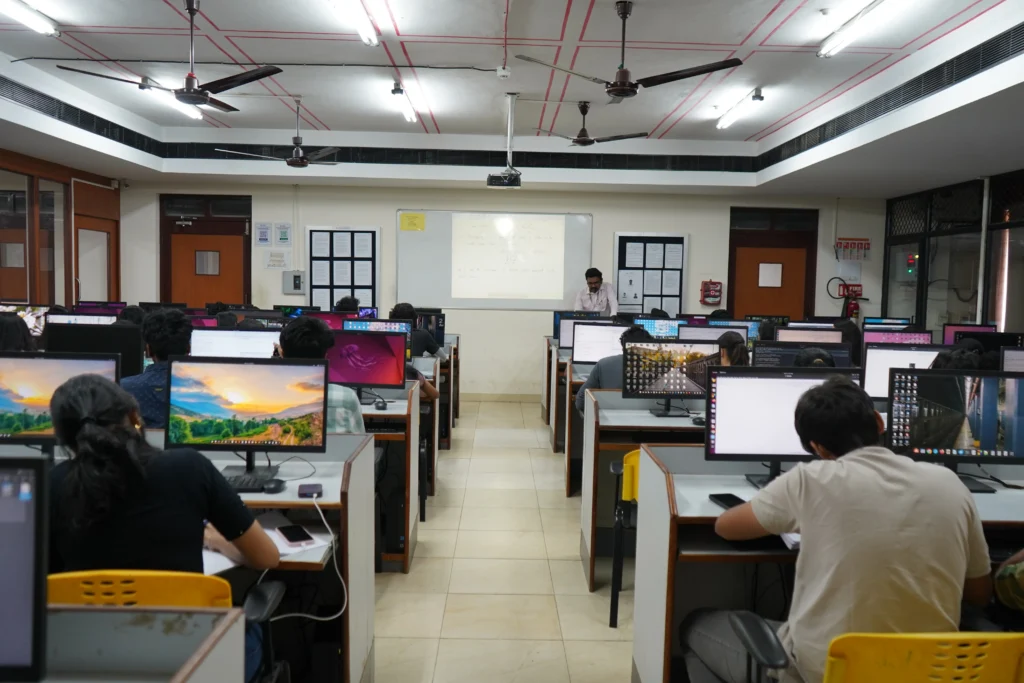
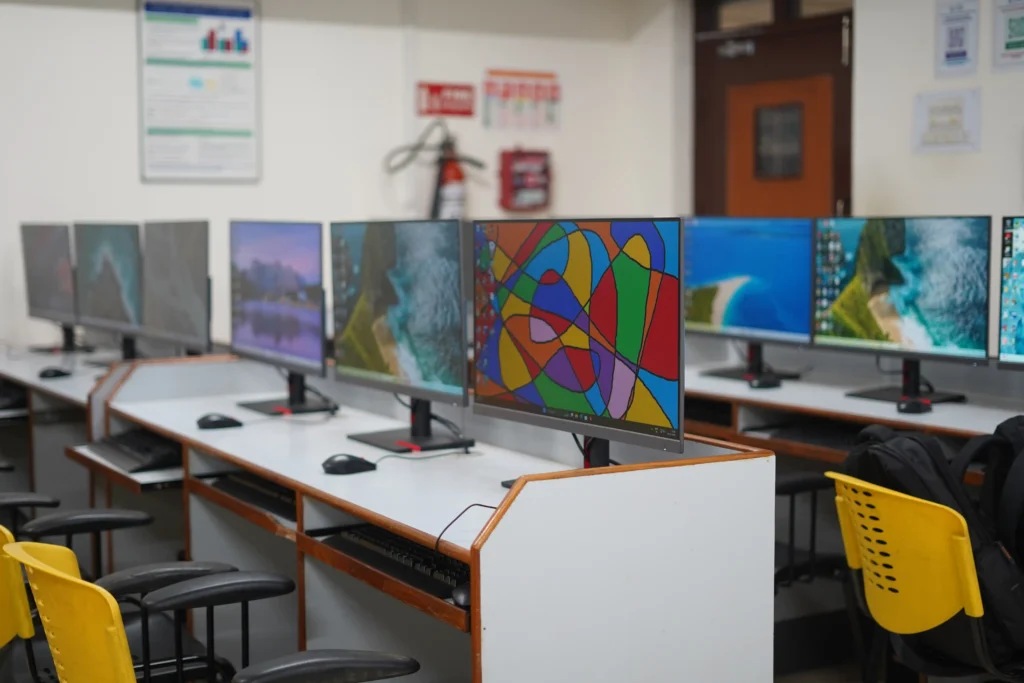
The Artificial Intelligence Laboratory, located at venue SJT 517, serves as a dedicated academic and research facility under the School of Computer Science and Engineering. It supports hands-on learning and experimentation for courses including Artificial Intelligence, Machine Learning, Deep Learning, Reinforcement Learning, Data Mining, and Advanced Data Analytics. The lab emphasizes the practical development of intelligent models and analytical frameworks using modern AI techniques, enabling students to apply computational intelligence methods to real-world, data-intensive problem domains.
Objectives
- To provide structured hands-on exposure to core machine learning and data science algorithms through well-defined laboratory experiments.
- To strengthen students’ understanding of data-driven modelling, optimization methods, and intelligent decision-making processes
- To support course-integrated projects, mini-projects, and capstone work in machine learning, artificial intelligence, and computational intelligence.
- To enable research-oriented learning by encouraging experimentation and exploration in emerging areas of artificial intelligence and data analytics.
- To promote the effective use of industry-standard, open-source frameworks and tools for building scalable, efficient, and reproducible machine learning solutions.
- To foster interdisciplinary applications of machine learning across domains such as healthcare, finance, smart systems, automation, and intelligent services.

Key Focus Areas
- Machine Learning Algorithms: Supervised, unsupervised, and ensemble learning techniques for classification, regression, and clustering problems.
- Deep Learning: Neural networks, convolutional and recurrent architectures, transformer models, and representation learning methods.
- Machine Learning for Data Science: Data preprocessing, feature engineering, model evaluation, explainability, and performance analysis
- Computational Intelligence Techniques: Evolutionary algorithms, swarm intelligence, fuzzy logic systems, and hybrid AI models
- Optimization and Intelligent Decision Making: Metaheuristic and learning-based optimization strategies for complex problem domains.
- Applied AI and Analytics: Use of real-world datasets, case studies, and domain-specific applications to solve practical problems
- Research and Innovation: Algorithm benchmarking, experimental evaluation, prototype development, and innovation-driven exploration
Research Publications
- Yenduri, Gokul, Ramalingam Murugan, Praveen Kumar Reddy Maddikunta, Sweta Bhattacharya, Devulapalli Sudheer, and Bharath Bhushan Savarala. “Artificial general intelligence: Advancements, challenges, and future directions in AGI research.” IEEE Access (2025).
- Balakrishnan, P., A. Anny Leema, N. Jothiaruna, Purshottam J. Assudani, K. Sankar, Madhusudan B. Kulkarni, and Manish Bhaiyya. “Artificial intelligence for food safety: From predictive models to real-world safeguards.” Trends in Food Science & Technology 163 (2025): 105153.
- Khekare, Urvashi, and Rajay Vedaraj IS. “Adaptive deep Q-networks for accurate electric vehicle range estimation.” Frontiers in Big Data 8 (2025): 1697478.
- Rosi, A., N. Suresh, Akp Kovendan, Khaled Tawfiq Al-Assaf, Amit Dutt, and G. Karthikeyan. “Hybrid AI Model for Fake Product Review Identification.” In 2025 8th International Conference on Circuit, Power & Computing Technologies (ICCPCT), pp. 524-529. IEEE, 2025.