


Embedded Systems Lab
Embedded Systems Lab
Overview
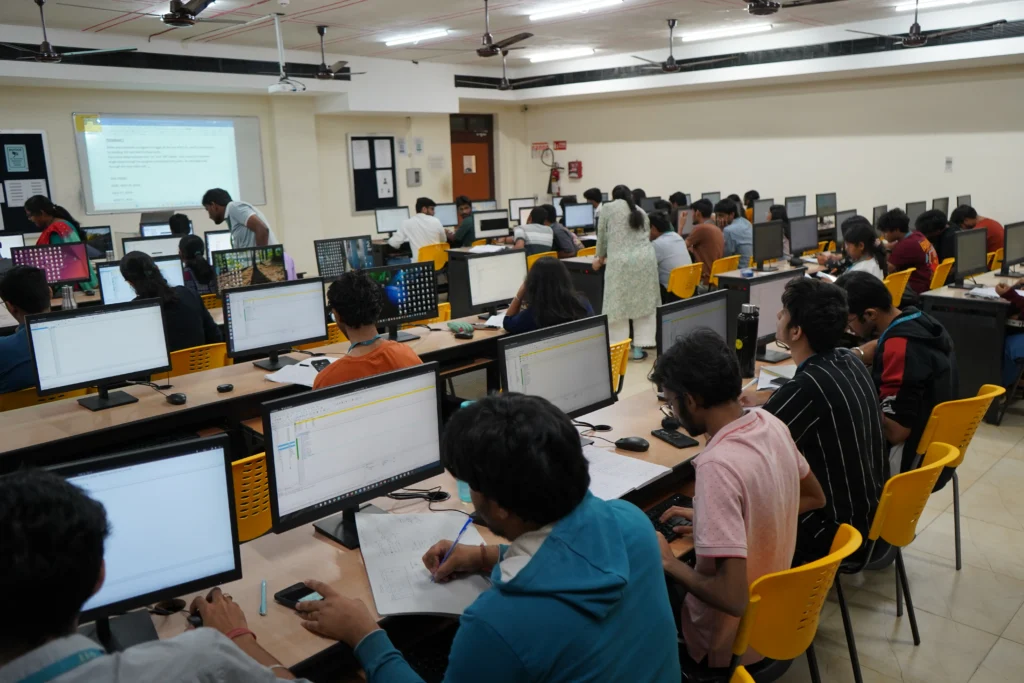
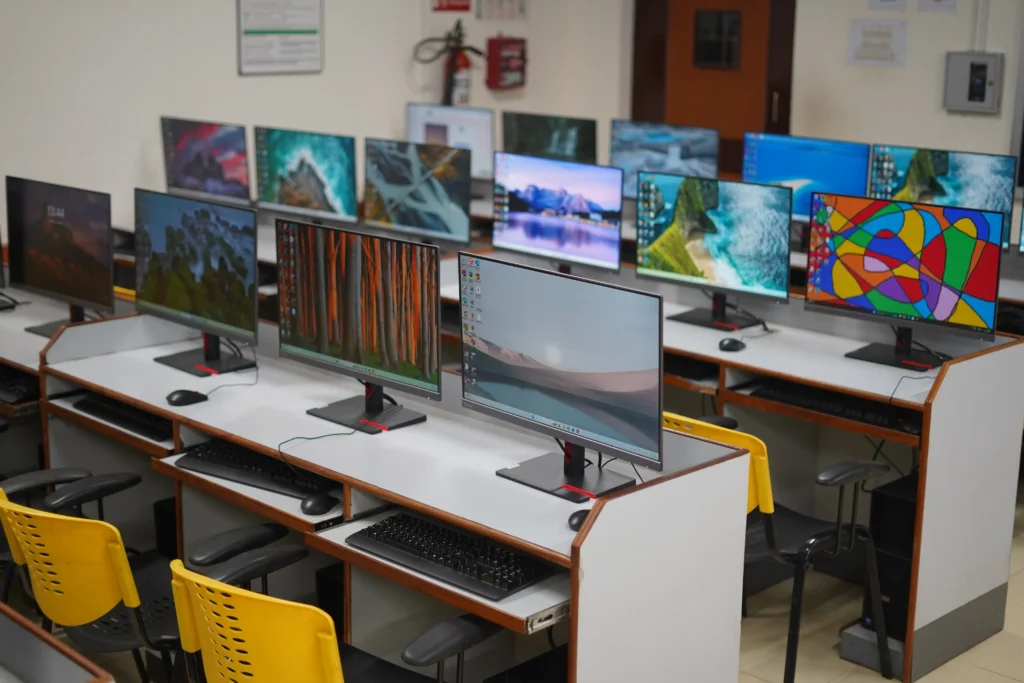
The Embedded Systems Laboratory provides practical training in embedded system design integrating hardware and software using 8051, PIC, and ARM platforms. The lab applies Digital Logic and Computer Design concepts such as combinational and sequential circuits, memory, and processor architecture through hands-on interfacing. Students develop skills in embedded C and assembly programming, real-time systems, and communication protocols, supporting industry-oriented skills, innovation, and IoT-based embedded applications
Objectives
- To strengthen theoretical concepts of microcontrollers, microprocessors, and embedded systems through hands-on laboratory experiments
- To train students in peripheral interfacing, interrupt handling, and timer-based applications.
- To enhance problem-solving and analytical skills through experiment-driven learning.
- To promote research activities in embedded systems, real-time computing, and low-power system design
- To support undergraduate, postgraduate, and doctoral research projects in emerging embedded technologies
- To encourage innovation in areas such as IoT, automation, and intelligent embedded applications


Key Focus Areas
- Application of Digital Logic and Computer Design concepts such as number systems, Boolean logic, combinational and sequential circuits, FSMs, memory and CPU organization.
- Microprocessor and microcontroller architecture, instruction sets and internal functional blocks.
- Interfacing techniques for I/O devices, timers, counters, memory, ADC/DAC, sensors and actuators.
- Embedded C and assembly language programming for real-time applications.
- Use of communication protocols such as UART, SPI and I²C.
- Hardware–software co-design, debugging and testing of embedded systems.
- Development of mini-projects and prototypes for IoT, automation and intelligent embedded applications
Recent Research Publications:
- Jay Kaoshik., Pranav Vyas., V. Vijayarajan and N. Badrinath (2025) “High-Yield Model Compression Paradigms for Low Footprint Signal Classification Supplementing Resource Constrained Embedded Environment.” Computational Intelligence in Communications and Business Analytics. DOI:10.1007/978-3-031-81339-9_21
- J. Dheeba., Vansh Oberoi., R. Raja Singh and V. Karthik (2025) “Securing Electrical Drive Systems Against Man-in-the-Middle Attacks Using S-Box Optimized AES Encryption.” IEEE Access. DOI: 10.1109 /ACCESS. 2025.3584926
- Nithya S.,Sujatha V.,Rama Prabha K P & Saravanan V (2025) “Design and implementation of cost-effective flexible paper based Wi-Fi sensor for commercial applications.”Analog Integrated Circuits and Signal Processing, Volume 124, Issue 2.DOI: 10.1007/s10470-025-02433-w.
- Supriya Sridharan., Swaminathan Venkataraman and S. P. Raja (2025) “SOC Estimation in Lithium Ion Batteries using a Hybrid Gated Residual Wavenet with LSTM-GRU Network Across Varying Temperatures” Journal of The Electrochemical Society, Volume 172, Number 3, DOI 10.1149/1945-7111/adbb23
- Gajula Rukshana Bi; Mayank Motwani; Sumit Kumar Jindal (2025) “Analytical Formulation and Numerical Investigation of Electromechanical Dynamics in Circular Biconvex Diaphragm Capacitive Pressure Sensor” IEEE Sensors Journal, Volume: 25 Issue: 11, DOI: 10.1109/JSEN.2025.3558290.