


Gen AI Lab
Gen AI Lab
Overview
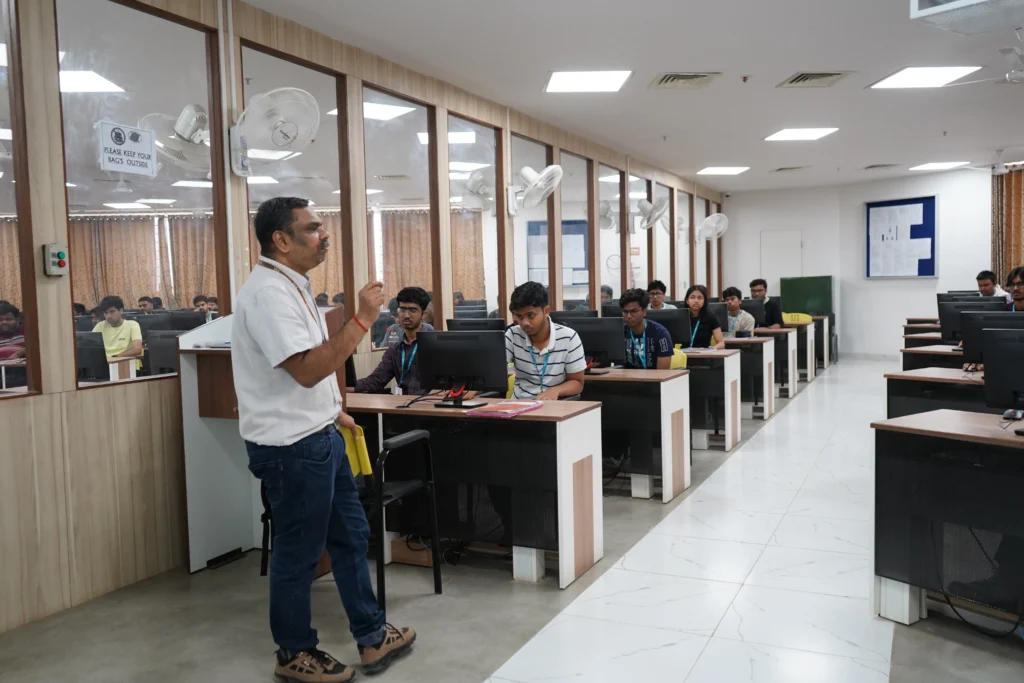
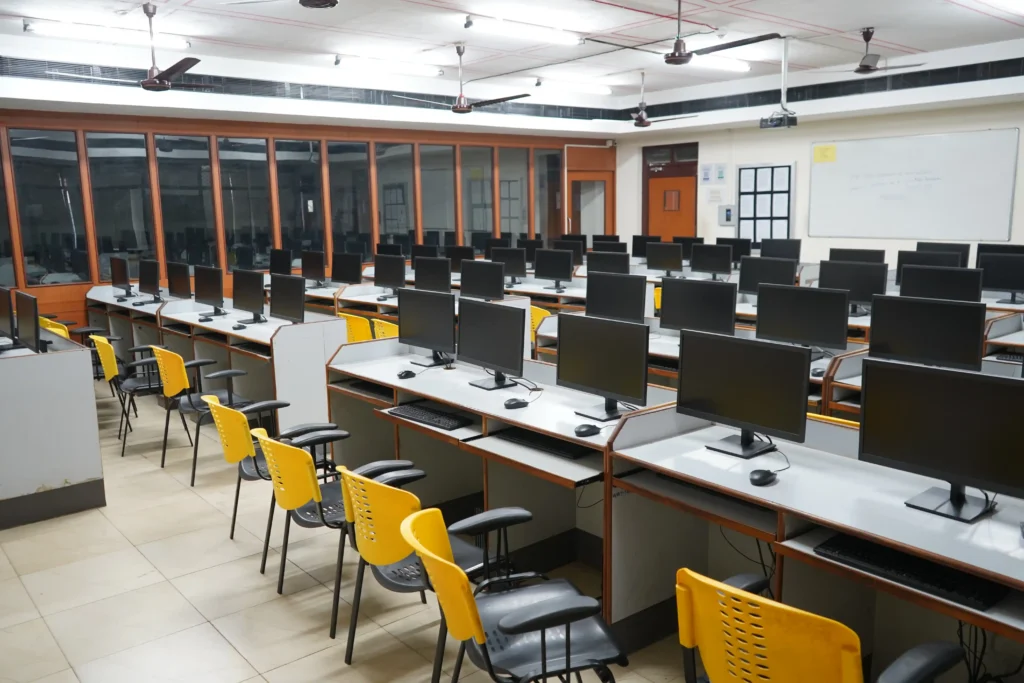
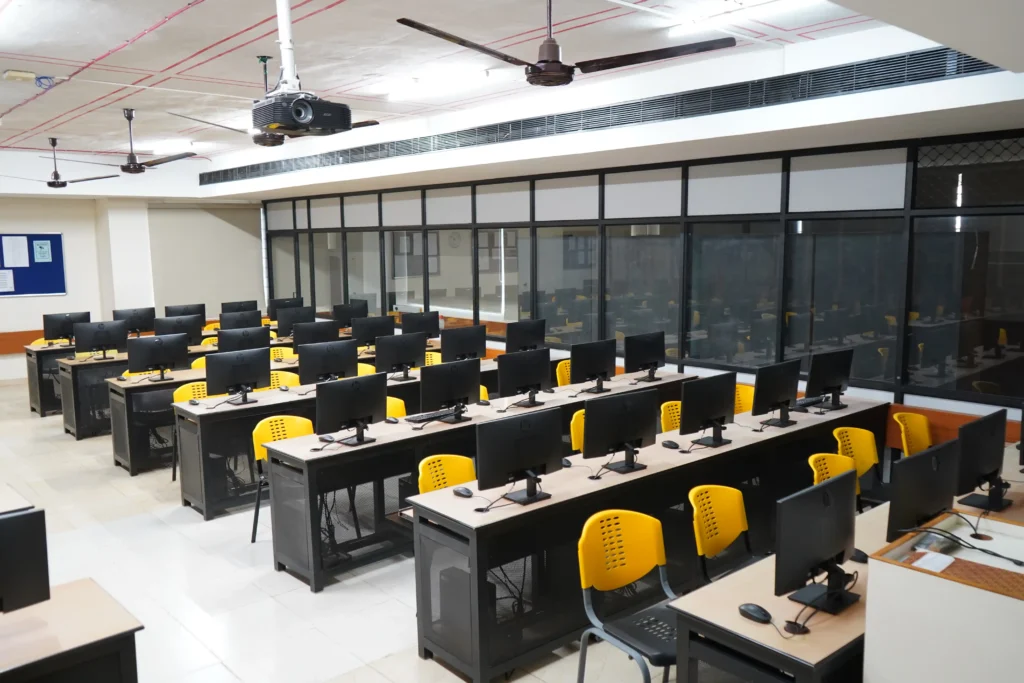
The GenAI Laboratory is a dedicated teaching and research facility that supports Generative AI and LLM courses under the School of Computer Science and Engineering (SCOPE), VIT Vellore Campus. The lab focuses on the development and application of AI models, including deep learning architectures, evolutionary optimization methods, fuzzy systems, and hybrid AI techniques for solving complex, data-driven problems.
Objectives
- To provide hands-on exposure to building systems that can generate text, images, code, audio, and other content using modern AI models.
- To strengthen the understanding of large language models, diffusion models, and prompt engineering through practical experiments
- To design, train, fine-tune, and deploy generative models using contemporary tools and frameworks
- To emphasize ethical AI practices, responsible usage, bias mitigation, and evaluation of generated outputs
Key Focus Areas
- Generative Representation Learning: Unsupervised and self-supervised learning, autoencoders, variational autoencoders, GANs, CycleGANs, and latent space modeling.
- Transformer-Based Generative Models: Attention mechanisms, transformers, large language models (BERT, GPT, LLaMA, T5), vision transformers, and diffusion-based generative models.
- Prompt Engineering and Reasoning: Zero-shot, few-shot, and chain-based prompting, Chain-of-Thought and Tree-of-Thought reasoning, role prompts, and task templates.
- Multimodal Generative AI: Vision–language transformers, multimodal embeddings (CLIP), multimodal generation (BLIP), and text–image integration.
- Model Fine-Tuning and Alignment: Embedding models, SBERT, task-specific fine-tuning, instruction tuning with QLoRA, and reinforcement learning from human feedback (RLHF).
- Evaluation, Ethics, and Responsible AI: Generative model evaluation metrics, bias and ethical concerns, misinformation and deepfakes, and intellectual property considerations.
Recent Research Publications:
- Jyoti, Shivya, and Moulik Tejpal. “Optimizing Generative AI Applications: A
Comparative Study of Effective Prompting Techniques.” In 2025 5th
International Conference on Pervasive Computing and Social Networking
(ICPCSN), pp. 389-396. IEEE, 2025.[SCOPUS] - Raji, N. R., C. L. Biji, and V. Vineetha. “Multi-modal generative ai for people with disabilities.” In Multimodal Generative AI, pp. 271-296. Singapore: Springer Nature Singapore, 2025. [SCOPUS]
- Rajasekar, Elakkiya, and V. Subramaniyaswamy, eds. Generative AI and Creativity: From Theory to Practice. CRC Press, 2025. [SCOPUS]
- Rajarajeswari, P., R. V. Saraswathi, Y. Jahnavi, V. Ravuri, S. Alankritha, M. S. Vani, and S. Gaftandzhieva. Performance evaluation of generative adversarial networks for anime face synthesis using deep learning approaches. Multidisciplinary Science Journal, 7 (3). Scopus. 2025. [SCOPUS]
- Balaji, K. “Pervasive Multifaceted Process based Generative Adversarial Network for Image Quality Enhancement.” Applied Soft Computing (2025): 113780. [SCIE-IF-6.6]
- Mukherjee, Souvik, Soosan Shabnam, Sara Hasan, and D. Ajitha. “Enhancing Retrieval Augmented Generation Systems Using AI Models and Graph Databases.” In 2025 International Conference on Emerging Smart Computing and Informatics (ESCI), pp. 1-5. IEEE, 2025. [SCOPUS]
- Verma, Kavya, Divyanshi Mittal, Sagnik Samanta, Kabir Gulati, Ojas Kulkarni, Muzaffar Ahmad Dar, and C. L. Biji. “Deepfake audio detection: A comparative study of advanced deep learning models.” IEEE Access (2025). [SCIE-IF-3.6]
- Pandian, J. Arun, Ramkumar Thirunavukarasu, and Rajganesh Nagarajan. “Enhanced exploration in reinforcement learning using graph neural network based intrinsic reward mechanism.” Scientific Reports 15, no. 1 (2025): 39986. [SCIE-IF-3.9]
- Golovin, Aleksei, Nataly Zhukova, Radhakrishnan Delhibabu, and Alexey Subbotin. “Improving Recommender Systems for Fake News Detection in Social Networks with Knowledge Graphs and Graph Attention Networks.” Mathematics 13, no. 6 (2025): 1011. [SCIE-IF-2.2]